
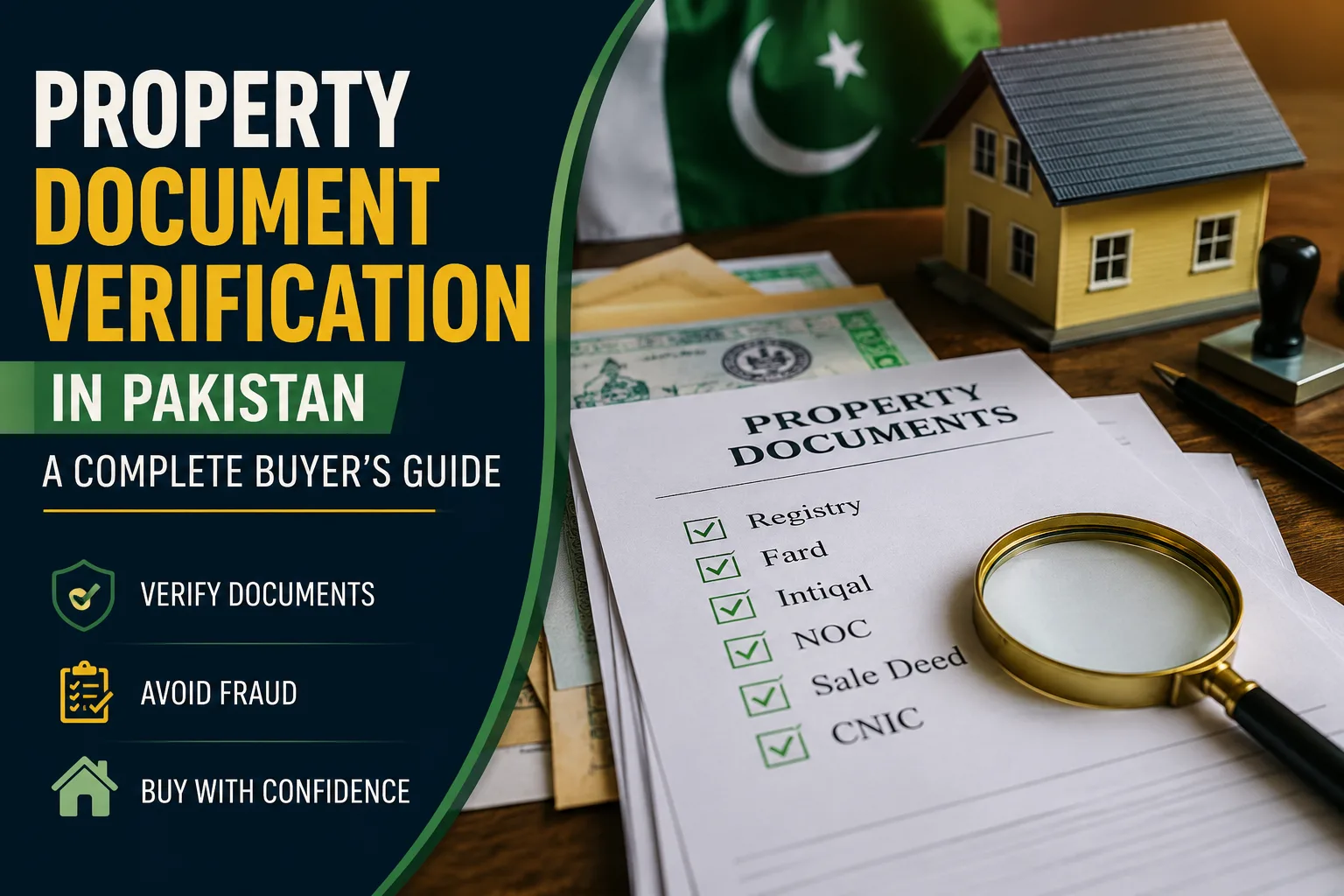
Buying property is exciting until the paperwork begins and everyone starts speaking in Registry, Fard, Intiqal, NOC, and allotment-letter language. Property document verification in Pakistan becomes much easier when you check the right records in the right order.
Whether you are buying a plot, house, apartment or commercial unit, never treat a low price, glossy brochure or confident agent as proof that the deal is safe. Verify the project, seller and exact property before paying token money, booking charges or a major advance.
With professional guidance from Apex Estates, buyers can better understand the required documents, identify potential warning signs and make a more informed property decision.
Property Document Verification in Pakistan: Quick Checklist
| What to verify | What to check | Where to confirm |
| Project approval | NOC, layout plan and approved blocks | Relevant development authority |
| Seller’s identity | Original CNIC and authority to sell | Original documents and legal review |
| Ownership | Registry, sale deed, allotment or transfer record | Registrar, land record or society |
| Land record | Fresh Fard and Intiqal status | Provincial land-record authority |
| Exact property | Plot, floor, unit, dimensions and land use | Approved plan and site inspection |
| Legal and financial risk | Cases, mortgages, taxes and outstanding dues | Lawyer, authority and society |
1. Identify the Property Type
A housing-society plot, privately owned land, constructed house, and high-rise apartment do not use the same paperwork.
A plot buyer may need to check:
- Land records
- Physical boundaries
- Plot number and dimensions
- Approved land use
- Possession status
An apartment buyer should also verify:
- Approved building plan
- Floor and unit number
- Development permission
- Payment record
- Possession terms
- Maintenance charges
Ask the seller or developer for a written list of documents that establishes ownership and confirms the right to sell the exact property.
2. Verify the NOC and Project Approval
When buying inside a housing scheme or development project, check its status directly with the responsible development authority.
Do not rely only on:
- An advertisement
- A WhatsApp screenshot
- A dealer’s verbal promise
- The phrase “NOC is under process”
In Islamabad, private housing schemes generally pass through separate approval stages. An approved Layout Plan and an issued NOC may represent different stages of approval.
Therefore:
“Layout approved” does not always mean that the project has received full development approval.
Check whether the exact:
- Phase
- Block
- Extension
- Tower
- Commercial section
is included in the approval.
An NOC can help confirm a project’s regulatory status, but it does not automatically prove that the seller owns your specific plot or unit.
3. Match the Seller With the Ownership Record
Ask to see the seller’s:
- Original CNIC
- Original ownership documents
- Transfer record
- Authority to sell
The name and identification details should match the current ownership record.
Depending on the property, ownership evidence may include:
- Registered sale deed
- Registry
- Allotment letter
- Transfer letter
- Sub-lease
- Conveyance deed
A utility bill or physical possession does not independently prove legal ownership.
Where someone is acting through a Power of Attorney, have its validity, scope, and current legal status reviewed before making payment.
4. Review the Complete Ownership Chain
Do not check only the latest document.
Review how ownership moved from the original owner to the current seller.
Watch for:
- Missing transfers
- Inconsistent names
- Different plot or unit numbers
- Unexplained overwriting
- Conflicting measurements
- Unrecorded inheritance transfers
- Previous agreements that were never cancelled
For inherited property, confirm that the legal heirs and required succession documents have been properly addressed.
A problem earlier in the ownership chain can affect the current sale and even when the latest document looks genuine.
5. Check Registry, Fard and Intiqal
These documents perform different functions.
Registry
A Registry or registered sale deed records the property transaction through the relevant registration system.
Fard
A Fard is an extract of the land record showing recorded ownership rights and property details.
Intiqal
Intiqal, also known as mutation, updates the ownership entry in the revenue record following a:
- Sale
- Gift
- Inheritance
- Court order
- Other legally recognized transfer
In Punjab, land-record services are available through the Punjab Land Records Authority and Arazi Record Centre’s. Other provinces and jurisdictions use their own systems and procedures.
A Fard is important, but it may not reveal every issue involving:
- Mortgages
- Litigation
- Previous sale agreements
- Possession disputes
- Inheritance claims
- Unrecorded interests
Never rely on one document as complete proof that a property is safe to purchase.,
6. Match the Property With the Approved Plan
The property shown on the ground must match the property described in the documents.
For a plot, confirm:
- Plot number
- Block
- Dimensions
- Physical boundaries
- Khasra details, where applicable
- Approved land use
For an apartment or commercial unit, verify:
- Project and tower name
- Floor and unit number
- Covered area
- Approved building plan
- Residential or commercial use
- Parking rights
- Shared-area rights
Be careful when:
- Physical dimensions differ from the documents
- An advertised floor is missing from the approved plan
- A residential unit is being sold for commercial activity
- The unit number differs across the agreement and layout
- Extra construction has been added without approval
7. Confirm Possession and Development Status
Ask for the Possession Letter when the property is described as possession ready.
Confirm possession directly with the:
- Housing society
- Developer
- Development authority
- Relevant transfer office
For an under-construction property, the agreement should clearly explain:
- Estimated completion date
- Possession timeline
- Installment schedule
- Development charges
- Utility charges
- Cancellation terms
- Refund conditions
- Late-payment penalties
- Consequences of delayed delivery
“Possession coming soon” is marketing. Written contractual terms are what protect the buyer.
8. Investigate Mortgages, Litigation and Disputes
Check whether the property is affected by:
- A bank mortgage
- Registered charge
- Court case
- Stay order
- Inheritance dispute
- Previous sale agreement
- Disputed Power of Attorney
- Unpaid society obligations
- Restriction on transfer
There may not be one universal document called a “No-Litigation Certificate” for every property transaction in Pakistan.
The correct checks depend on the:
- Jurisdiction
- Property type
- Ownership history
- Development authority
- Housing society
For a high-value property purchase, an independent legal title review is usually worth the cost.
9. Check Taxes and Outstanding Dues
Request current information about:
- Property tax
- Electricity bills
- Gas bills
- Water charges
- Maintenance fees
- Development charges
- Society dues
- Outstanding installments
These records help identify unpaid liabilities, but they do not replace ownership documents.
A paid utility bill proves that a bill was paid, it does not prove that the account holder owns the property.
Ask for a written breakdown of:
- Transfer fees
- Applicable taxes
- Dealer commission
- Maintenance charges
- Development dues
- Outstanding installments
This prevents an apparently affordable deal from becoming expensive after transfer.
10. Use Safe and Traceable Payment Practices
Avoid large cash payments without proper documentation.
Use:
- Traceable banking channels
- Signed receipts
- Written agreements
- Clearly stated payment purposes
- Official company or seller accounts
Never sign:
- Blank forms
- Blank stamp papers
- Incomplete agreements
- Undated documents
- Papers containing unexplained empty spaces
Keep copies of:
- Advertisements
- WhatsApp conversations
- Receipts
- Identity documents
- Signed terms
- Payment records
When token money is required, the written receipt should mention:
- Exact property
- Buyer and seller
- Amount paid
- Remaining payment
- Verification period
- Refund conditions
- Transfer deadline
Common Property Fraud Red Flags
Slow down when:
- The price is far below market value without a reasonable explanation
- The seller refuses to show original documents
- You are pressured to pay “today only”
- Project approval is repeatedly described as “coming soon”
- Plot or unit details differ across documents
- Payment is requested in an unrelated personal account
- The seller discourages legal review
- A site visit is being avoided
- A screenshot is shown instead of a live official record
- “Guaranteed returns” or “zero-risk” claims have no clear written terms
- The seller refuses to provide a proper payment receipt
A genuine property opportunity should survive basic verification.
When a deal disappears because you asked for documents, the verification process may have saved you from a much bigger problem.
Recommended Property Verification Process
Follow this order before completing a purchase:
- Identify the exact property
- Check the seller’s identity
- Review original ownership documents
- Verify project approval and NOC status
- Check Registry, Fard and Intiqal
- Match the property with the approved plan
- Inspect the property physically
- Check mortgages, disputes and dues
- Obtain independent legal advice where necessary
- Pay through a traceable channel
- Complete the official transfer process
Frequently Asked Questions
How can I verify property ownership in Pakistan?
Check the seller’s CNIC and original ownership documents, verify the relevant Registry or allotment record, review the ownership chain and complete the official transfer through the responsible registrar, development authority or society.
How do I verify a housing society’s NOC?
Identify the development authority responsible for the area and check its official project records.
Confirm the exact phase, block and extension rather than accepting a general claim that the entire society is approved.
Is a Fard enough to prove property ownership?
Not always.
Buyers may also need to check:
- Registry
- Intiqal
- Ownership history
- Possession
- Mortgages
- Litigation
- Seller’s authority to transfer
What is the difference between Registry and Intiqal?
A Registry records the property transaction, while Intiqal updates the ownership entry in the revenue record.
A careful buyer checks whether both records are complete and consistent where applicable.
Can property documents be checked online in Pakistan?
Some records can be checked online, but coverage differs between provinces, districts and property types.
Online information may still need to be confirmed through the relevant land-record center, development authority, registrar or housing society.
Which documents should I check before buying an apartment?
Check the:
- Seller or developer’s authority to sell
- Allotment or sale agreement
- Approved building plan
- Floor and unit number
- Payment record
- Development permission
- Possession terms
- Maintenance charges
- Transfer conditions
Should I pay token money before document verification?
Complete the basic seller, project and property checks first.
Where token money is required, use a written agreement stating the exact property, amount, verification period, refund conditions and responsibilities of both parties.
How can overseas Pakistanis verify a property?
Overseas buyers should use independently verified representatives, obtain original or certified records, confirm approvals directly with the relevant authority, and avoid relying entirely on agents or relatives.
A qualified lawyer can also review the ownership chain and transaction documents before payment.
Need Help Reviewing Property Documents?
Buying property should never begin with pressure, incomplete information, or guesswork.
Share the available ownership documents, property type, location and project details with the APEX23 Developers team. The team can help you understand which records and approvals should be checked before you proceed.
Talk to the APEX23 Developers team.
Verification requirements differ between provinces, development authorities, housing societies and property types. Independent legal advice may be necessary before signing an agreement, paying token money or completing a transfer.
For guidance on property document verification in Pakistan, project approval status or real-estate opportunities, contact APEX23 Developers.
Phone: +92 51 111 000 123
WhatsApp/Phone: +92 337 962 3190
Email: businesses@apexestatespak.com
Location: Western Half, 3rd Floor, 72-West, Opposite Saudi Pak Tower, Blue Area, Islamabad
Disclaimer: This article provides general educational information and is not a substitute for legal, tax, financial, or regulatory advice. Always verify current information through the relevant authority and seek qualified professional advice before completing a property transaction.