
The Ultimate Strategic Property Investment Framework: How to Build a Market-Beating Portfolio. Real estate is not merely about owning square footage. It is about the strategic allocation of capital into assets designed to yield exponential growth.
Whether you are acquiring your first property or expanding an established portfolio, one rule applies: the difference between a stagnant asset and a market-beating portfolio is defined by the depth of your due diligence.
At APEX23 Developers, we treat property acquisition as an exact science. Many investors fall into the trap of “emotional buying”—falling in love with aesthetic finishes or relying on market hype.
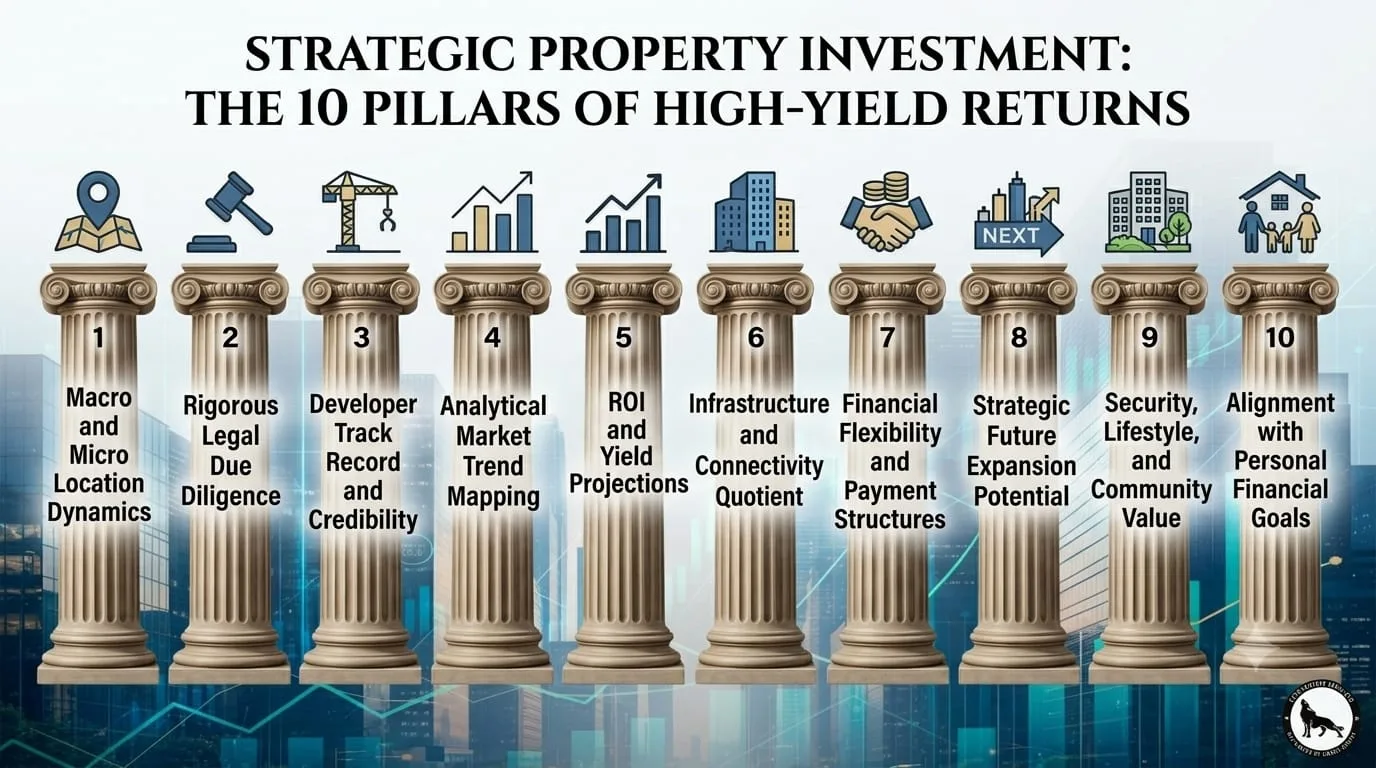
To eliminate guesswork and protect your capital, we developed the APEX23 Developers Standard: a 10-point, research-backed framework to evaluate property opportunities, manage risk, and maximize long-term wealth.
Strategic Blueprint: The 10-Point Investment Audit
                  ┌──────────────────────────────────────────┐
                  │        APEX23 Developers DUE DILIGENCE         │
                  └────────────────────┬─────────────────────┘
                                       │
        ┌──────────────────────────────┼──────────────────────────────┐
        ▼                              ▼                              ▼
  LOCATION & MARKET              LEGAL & FINANCE                LIFESTYLE & GOALS
  • Macro/Micro Dynamics         • Legal Verification           • Security & Amenities
  • Absorption & Supply          • Yield & ROI Metrics          • Portfolio Alignment
  • Infrastructure Assets        • Payment Structure & IRR
  • Expansion Potential          • Developer History
1. Macro and Micro Location Dynamics
Location is the core engine of capital appreciation. However, evaluating general geography only reveals half the picture.
Experienced investors analyze micro-market dynamics to spot hyper-local value drivers.
1.Macro vs. Micro Dynamics
-
Macro Location: Encompasses the broader city or metropolitan region. Focus on job growth, regional population inflow, and broad economic output.
-
Micro Location: Focuses on the exact neighborhood, street, or block. Evaluate localized foot traffic, proximity to noise, zoning regulations, and school district ratings.
2. Rigorous Legal Due Diligence
A property with strong financial potential becomes a liability if ownership is bogged down in legal disputes. Never rely on verbal promises or informal broker assurances.
A thorough legal review rests on three core pillars:
Legal Verification Matrix
| Legal Pillar | Critical Focus | Action Item |
| Title Verification | Ownership History | Confirm a clear title deed free of liens, mortgages, or third-party claims. |
| Regulatory Compliance | Municipal Approvals | Verify all required No Objection Certificates (NOCs) and building permits. |
| Contractual Terms | Sale Agreements | Review penalty clauses, delivery timelines, and transfer fee structures. |
Completing stringent legal verification before committing capital safeguards your initial investment and prevents expensive litigation.
3. Developer Track Record and Credibility
A project is only as reliable as the developer behind it. Construction delays lower your net returns by tying up equity without generating rental income.
Evaluate a developer’s historical performance using three key metrics:
-
Delivery Timelines: Review past projects to confirm on-time delivery standards.
-
Build Quality: Inspect older developments from the same builder to evaluate structural integrity and ongoing maintenance quality.
-
Financial Solvency: Ensure the developer holds sufficient capital reserves rather than relying entirely on pre-sale cash flows to finance construction.
Partnering with established developers protects your principal against project stalls and structural defects.
4. Analytical Market Trend Mapping
Real estate decisions require objective market data. To capture optimal entry points, monitor supply-and-demand indicators continuously:
-
Absorption Rate: Tracks the speed at which available properties are sold or leased within a specific timeframe. High absorption indicates strong demand.
-
Inventory Pipeline: Assesses upcoming supply. Overbuilding in a sub-market suppresses rental rates and limits price growth.
-
Days on Market (DOM): Measures average listing duration. Declining DOM points to a shifting market where sellers hold pricing leverage.
       [ Buyer's Market ] ───► [ Sweet Spot Entry ] ───► [ Seller's Market ]
       High Inventory          Accelerating Demand        Low Inventory
       Price Discounts         Optimal Risk/Reward        Peak Valuations
Analyzing these trends allows you to enter emerging markets right before major price accelerations occur.
5. ROI and Yield Projections
The Core Concept: Rental Yield vs. Total ROI
When evaluating real estate performance, you need to look at two distinct financial metrics:
-
Rental Yield: Measures the annual cash flow (income) generated by the property relative to its purchase price.
-
Total ROI (Return on Investment): Measures the total financial gain (income + value growth) relative to the initial equity you actually invested.
1. Rental Yield Formulas
A. Gross Rental Yield
This gives you a quick snapshot of income before deducting any expenses.
B. Net Rental Yield
This is the true measure of cash flow, taking into account all holding and management costs.
2. Total ROI Formula
Total ROI accounts for both your ongoing cash flow and asset price growth (capital appreciation) over time.
Step 1: Calculate Operating & Holding Costs
Real estate incurs holding costs. Let’s tally the annual expenses:
-
Property Taxes: $3,600
-
Insurance: $1,200
-
HOA / Maintenance Fees: $1,800
-
Property Management (8%): $2,400
-
Vacancy Allowance (approx. 5%): $1,500
-
Annual Mortgage Payments (Principal + Interest): $14,400
Total Annual Expenses & Mortgage: $24,900
Step 3: Compute Net Cash Flow
Subtract total annual expenses from your gross rent:
Step 4: Calculate the Yields
1. Gross Rental Yield
Gross Rental Yield is a real estate metric used to estimate how much rental income a property generates compared to its purchase price.
Formula
Gross Rental Yield (%) = (Annual Rental Income Property /Value or Purchase Price) ×100
2. Net Rental Yield (Operating Income / Purchase Price)
Net Rental Yield measures the actual return on a property investment after accounting for operating expenses. It gives a more realistic picture of profitability than Gross Rental Yield.
Formula
Net Rental Yield (%) = (Operating Income/Purchase Price) ×100
Step 5: Factor in Capital Growth & Calculate Total ROI
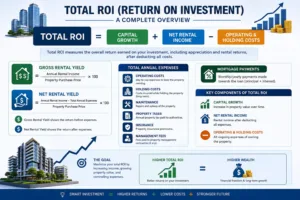
Capital Growth (also called Capital Appreciation) is the increase in a property’s value over time.
Formula
Capital Growth (%) =Current Property Value−Purchase Price/Purchase Price) ×100
Why Factor It In?
A property investor earns from:
- Rental Income (cash flow)
- Capital Growth (increase in property value)
If you only look at rental yield, you may undervalue a property that has strong appreciation potential.
Total ROI (Return on Investment) measures the overall return from a property investment by combining:
- Net Rental Income (cash flow)
- Capital Growth (property appreciation)
Formula
Total ROI (%) =Operating Income Capital Gain/Purchase Price) ×100
6. Infrastructure and Connectivity Quotient
Accessibility creates long-term real estate value. Properties integrated into major transportation networks record higher demand and lower tenant vacancy.
Primary Infrastructure Drivers
-
Transit Hubs: Direct access to subways, passenger rail, and bus rapid transit lines.
-
Arterial Networks: Fast access to major highways, beltways, and international airports.
-
Commercial Hubs: Reduced commute times to primary employment centers.
Connectivity drives tenant demand. Renters and buyers routinely pay a premium for locations that save daily commuting time.
7. Financial Flexibility and Payment Structures
Your Internal Rate of Return (IRR) depends directly on your capital deployment schedule and financing terms.
  [ Extended Installment Structure ]  ──►  Higher IRR (Defers Capital Outlay)
  [ Full Cash Upfront Payment ]      ──►  Lower Capital Flexibility
Whenever possible, utilize structured, construction-linked payment plans.
Additionally, projects backed by major commercial banks carry an added layer of security, as financial institutions conduct independent risk assessments before approving construction loans.
8. Strategic Future Expansion Potential
To achieve substantial capital growth, target areas where future infrastructure is expanding rather than mature markets that have already peaked.
Study municipal land-use plans, public transit expansion budgets, and state infrastructure projects.
Locations slated for new transit lines, public parks, or commercial zones often experience accelerated land value appreciation over a 3-to-7-year period.
9. Security, Lifestyle, and Community Value
Modern tenants select properties based on community integration and daily conveniences. Properties with comprehensive amenities maintain stronger resale values and steady rental income:
-
Security Infrastructure: 24/7 gated security, digital access systems, and professional management.
-
Wellness Facilities: Dedicated fitness centers, swimming pools, open green spaces, and walking paths.
-
Shared Amenities: Co-working lounges, conference rooms, and family recreation areas.
Amenity-rich developments sustain higher occupancy rates and premium rents, even during broader economic slowdowns.
10. Alignment with Personal Financial Goals
Every property in your portfolio should fulfill a designated financial function. Clarify your primary investment objective to prevent reactive buying:
                          ┌───────────────────────────┐
                          │   YOUR FINANCIAL GOAL     │
                          └─────────────┬─────────────┘
                                        │
             ┌──────────────────────────┴──────────────────────────┐
             ▼                                                     ▼
    [ PASSIVE CASH FLOW ]                                 [ WEALTH ACCUMULATION ]
    • Completed, income-producing units                   • Early-phase development projects
    • Immediate rental yield                              • Long-term capital growth
    • Reduced capital volatility                          • Accelerated equity building
Aligning each asset with your broader strategy keeps your portfolio focused and balanced over time.
Executive Due Diligence Checklist
Before making your next investment commitment, run through this final evaluation checklist:
-
Micro-Location Audit: Positioned inside an active or emerging growth corridor.
-
Legal Review: Clean title deeds, municipal NOCs, and agreements reviewed by counsel.
-
Developer Vetting: Builder’s delivery history and construction quality verified.
-
Data Mapping: Local absorption rates and inventory supply favor entry.
-
Financial Modeling: Net rental yields and cash flows modeled with all expenses included.
-
Infrastructure Access: Direct connectivity to major transit routes confirmed.
-
Payment Terms: Flexible payment structure or tier-one bank backing secured.
-
Master Plan Review: Area targeted for future public or private infrastructure spend.
-
Community Amenities: Professional management, security, and lifestyle amenities present.
-
Strategic Fit: Property aligns directly with your cash flow or equity growth goals.
Build Your Portfolio with APEX23 Developers
Successful property investment requires systematic risk mitigation and data-driven analysis. At APEX23 Developers, we bring clarity to complex real estate markets, helping investors identify assets built for security and superior performance.
Your path to building lasting wealth begins with informed decisions.
Ready to Secure Your Next High-Yield Asset?
-
Explore Curated Projects: View our portfolio of pre-vetted investment properties.
-
Schedule a Consultation: Contact our team today for a comprehensive portfolio analysis.